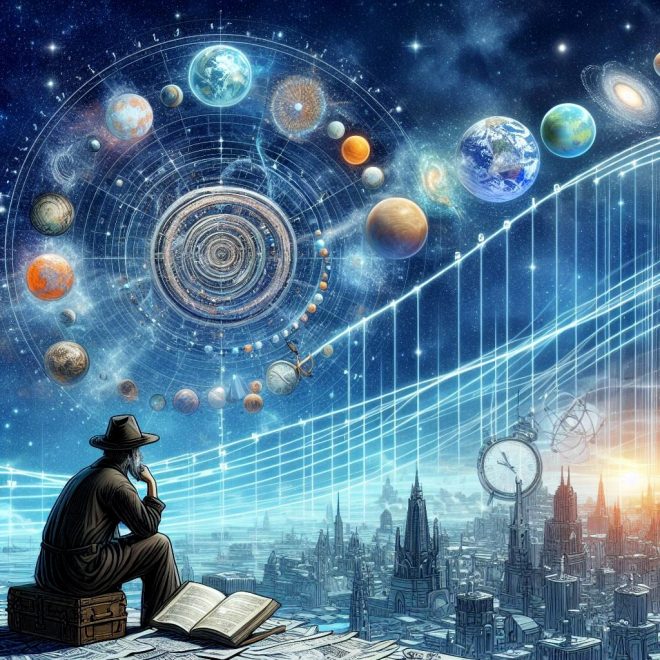
In the previous post (Worldview) I mentioned there are four presuppositions that are foundational to how we view Reality: Being, Ontology, Metaphysics, and Epistemology. This post will deal with Being. My objective here is not to give a comprehensive dissertation on these subjects, but simply to examine them from a practical standpoint, so we can understand how presuppositions affect our views today.
Being focuses on pure existence itself. What is existence? Is one’s existence timeless or temporal? A timeless existence transcends time and is static, unchanging, and generally viewed as perfect by those holding such a view. A temporal existence means that one changes over time; one exists in the process of becoming something different. In other words, one must presuppose time (temporality) or timelessness.
Theists generally believe God is perfect. Many then go a step farther and say therefore God must be timeless, static, and unchanging. Whether God can interact in the temporal realm depends on one’s ontological presuppositions though (see my post on this here).
Those who believe they exist in time (temporal existence) also have a choice to make as to whether time is linear or cyclic. If time is linear, we can imagine subsequent events in the universe moving along a straight timeline. Events are always unique because even if one repeats the same action, the time is different. Some religions including Hinduism, Jainism, Sikhism, and Buddhism regard time instead as cyclical (imagine a time wheel/circle), consisting of perpetually repeating ages. In this view, Reality is eternal but goes through cycles. For this to work, one’s ontological presupposition should be that the universe is a closed system (i.e., everything that happens is destined to happen, and there is no true free will to change the outcome). In contrast, monotheistic religions (among others) view time as linearly advancing, which places an important value on the use of one’s time, as every moment is unique. In either case, we cannot prove time is solely linear or whether the universe goes through repeating cycles.
In my view, when I consider these concepts, I think about how I can remember something that happened previously, implying I have moved through time; therefore, I am not existing in a static, timeless realm, but very much in a temporal one where change is possible. When I look at nature, and observe, for example, an insect egg hatching into a larva, then becoming a pupa, then taking on the adult form, then after some time passes, dying and its structure recycled back into nature, it is apparent to me as an individual that my existence is also currently of a limited duration, for I can look at pictures of myself as a baby, then a toddler, then a young boy, and so on until the present day–I see myself changing through time.
This of course has scientific implications as well, for if we existed in a timeless state, science, which requires testing hypotheses and making observations, would be impossible. That time consistently progresses in a linear manner is also critical for scientific observation, as otherwise knowing the effect over time of modifying an independent variable would be not only impossible to know, but also impossible to perform experimentally.
Finally, if time was linear, but inconsistent or jumped around, time travel would be very difficult, if not impossible. If you had a time machine and you plugged in a physical location and time, if the rate time moves changed randomly you could very well end up in a different physical location, and that would just not be good. So for the sake of the future I hope time moves forward consistently. ;P

 Biblical Lessons from Nature
4 thoughts on “Presupposition #1: Being”