In a previous post (Worldview) I mentioned there are four presuppositions that are foundational to how we view Reality: Being, Metaphysics, Ontology, and Epistemology. The last post dealt with Being. This post will deal with Metaphysics. My objective here is not to give a comprehensive dissertation on these subjects, but simply to examine them from a practical standpoint, so we can understand how presuppositions affect our views today.
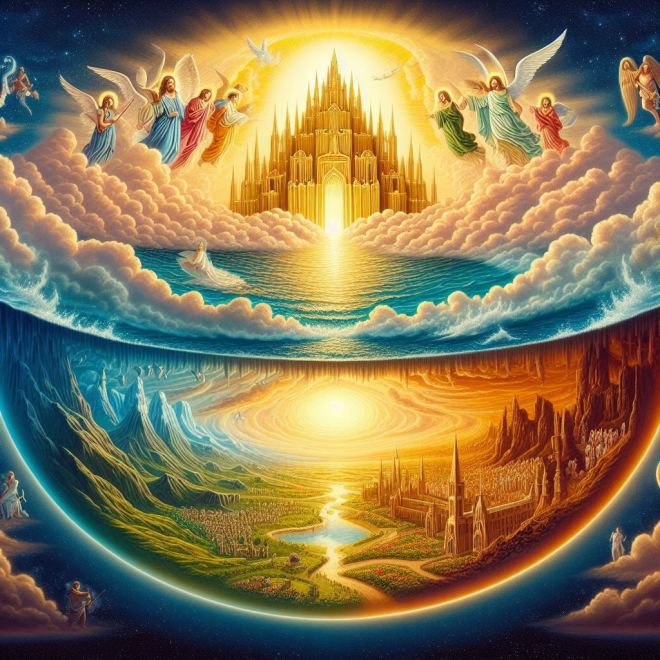
Metaphysics, for our purposes, is the question of whether there is a supernatural part to Reality or not. Is the natural world open or closed? Is there something beyond the material world? If the natural world is closed, there is no supernatural, and therefore everything can be described materialistically. This view is called materialism or naturalism. A non-materialistic view asserts that the natural world is open, the supernatural realm exists, and there are very real things that cannot be described in material terms.
Science is an investigation of the natural world, but the scientific system cannot work beyond the natural world. If something cannot be sensed using sight, sound, touch, taste, or smell, how can observations be made? What instruments can you use to test for the existence of the supernatural? None that I know of. Thus, no experiment can prove the supernatural, or should I say disprove materialism. Materialists (e.g., atheists) have presupposed that no supernatural realm exists, and claim there is no indubitable evidence for the supernatural (e.g., God). But this is an argument from silence, a logical fallacy. Materialism cannot, ironically, be proven through material/empirical means (alone at least). Yet, is there indubitable evidence that the supernatural does not exist? No, it takes faith either way; faith that your metaphysical presupposition (assumption) is correct.
This presupposition is important to understand especially in terms of the Creation/Evolution debate. For if one chooses to presume there is no supernatural, Creation by a supernatural being (i.e., God) could not possibly occur, and it is therefore meaningless and a waste of time to even consider any evidence put forth by a creationist. Yet many scientists refuse to acknowledge that they have chosen to not believe in the supernatural, and if they do, they claim that it is based on the overwhelming evidence in favor of materialism–something that science cannot have any say in. On the other hand, if one chooses to believe that there is a supernatural realm, then the existence of a supernatural being with sufficient power to create the universe can logically be considered. In other words, one’s presuppositional metaphysical choice determines whether one is open to special Creation or whether everything must have evolved materialistically by chance.
“It is not enough to say, ‘Something had to happen, so why not this?’ I find the confidence among the scientific establishment that the whole scenario will yield to a purely chemical explanation hard to understand, except as a manifestation of an axiomatic commitment to reductive materialism.”
Thomas Nagel (American philosopher), Mind and Cosmos, Oxford University Press, p. 49, 2012.
“Our willingness to accept scientific claims that are against common sense is the key to an understanding of the real struggle between science and the supernatural. We take the side of science in spite of the patent absurdity of some of its constructs, in spite of its failure to fulfill many of its extravagant promises of health and life, in spite of the tolerance of the scientific community for unsubstantiated just-so stories, because we have a prior commitment, a commitment to materialism. It is not that the methods and institutions of science somehow compel us to accept a material explanation of the phenomenal world, but, on the contrary, that we are forced by our a priori adherence to material causes to create an apparatus of investigation and a set of concepts that produce material explanations, no matter how counter-intuitive, no matter how mystifying to the uninitiated. Moreover, that materialism is absolute, for we cannot allow a Divine Foot in the door.”
Richard Lewontin (American scientist [1929–2021]), “Billions and billions of demons,” The New York Review of Books, 44(1):31, 9 January 1997.
Aside from the issue of origins, many scientists also do not like the idea of the existence of a supernatural realm because it allows a supernatural force or entity to put a “foot in the door,” to interfere with their experiments, changing the results without their knowing, or deceiving them into thinking something occurred through physical processes when it did not. Although this is a valid concern, is it a practical concern? I am not aware of any instances where a scientist has run into issues with experimental results due to supernatural tampering; of course, what scientist would dare suggest that? Certainly not a materialist. Ironically for the naturalist, there is no way to know whether a supernatural force acted on one’s experiments because the naturalist has a priori ruled out that possibility; even a special revelation by a supernatural being admitting they interfered would still not be considered proof or even valid evidence, as the naturalist would explain away their experience as the natural imaginations of their mind or a vivid hallucination, no more real than the dreams created by the brain’s neurons firing. On the other hand, if, after that revelatory experience, our naturalist chose to believe in the supernatural (change in presupposition), suddenly a whole new realm of possibilities opens up; and one could possibly explain one’s results in terms of both natural causes and effects and supernatural causes with physical effects. Yet, despite this being a real possibility, this idea is anathema to many scientists because of the downstream implications–not for the greater potential to more accurately explain Reality–but for certain religious/moral ideas that many scientists assume they would have to adopt. The truth is though, there are no religious/moral ideas that are explicitly necessary to adopt if one chooses to believe in the supernatural realm. In future posts, we will discuss some of these downstream possibilities. For now though, we will stick to exploring the foundational presuppositional level, examining ontology in the next post.
 Biblical Lessons from Nature
3 thoughts on “Presupposition #2: Metaphysics”