In a previous post (Worldview) I mentioned there are four presuppositions that are foundational to how we view Reality: Being, Metaphysics, Ontology, and Epistemology. The last post dealt with Metaphysics. This post will deal with Ontology. Both deal with the nature of Reality, but in my view Ontology goes a step further than Metaphysics. My objective here is not to give a comprehensive dissertation on these subjects, but simply to examine them from a practical standpoint, so we can understand how presuppositions affect our views today.
Ontology deals with your concept of universal Reality. There are four possible ontologies that I will discuss today: Monism, Animism, Unhappy Dualism, and Happy Dualism.
Monism
The first one is Monism, which assumes that all of Reality is composed of one impersonal element/thing/entity. There are different views on this. Materialism, for example, is a form of Monism that assumes an upper, spiritual level of existence does not exist–the universe is closed. Materialism is the ontology of Atheism, Marxism, Naturalism, Biological Determinism (i.e., all behavior is controlled by genes or some physiological component), and Humanism. In this case the essence of everything is physical matter; these various views/religions differ in the purpose of life but all are focused on human existence without any need for a salvation from the physical world. Another form of Monism is pantheism, which moves the spiritual realm completely into the material realm by equating the two: God is everything and everything is God–there is no distinction or separation–there is only one realm of Reality. Hinduism famously proclaims from the Upanishads that “Atman is Brahman.” To expand on this we can say “Atman [the essence of a person] is Brahman [the One, infinite, impersonal, ultimate Reality that is Everything].” So at its core, Hinduism is pantheistic; however, there is a hierarchy of appearances, with some forms closer to the One than others (e.g., matter/minerals<plants<animals<humans<enlightened ones<devas/deities<consciousness<One). A Hindu can thus worship deities but at the same time recognize the core truth that the worshiped and worshipers are both part of the same One. The goal of pantheistic monism is for adherents to overcome human ignorance and through meditation embrace the reality that they are Brahman and lose one’s complex self-consciousness and enter the undifferentiated One. (Sire, The Universe Next Door, pp. 144-155.) Buddhism is also a monistic religion similar to Hinduism in presuppositions. Both believe in an endless cycle of rebirth (reincarnation), until one becomes enlightened enough to reach Nirvana, the end of rebirth and suffering.
Animism
Another ontology is animism, which is distinguished from pantheism in its emphasis on the uniqueness of each individual soul, or undying essence, a.k.a. spirit. Pantheism ultimately maintains there is just one ultimate soul/spirit that is Reality, whereas Animism maintains there are countless spirits that inhabit some or all parts of the natural world. The upper spiritual level (spirit world) is very much connected with the physical world–the cosmos is a continuum of spirit and matter, but there is no infinite God, which distinguishes Animism from the dualistic ontologies I will discuss below. Animism can take many religious expressions including Paganism, Neopaganism, Ancestralism, and is reflected to some degree in the New Age, which tends to give it a more naturalistic slant. Paganism believes in multiple gods that normally exist in an invisible spiritual realm but that can interact with the physical world, creating, maintaining, or destroying / causing chaos. In Ancestralism, spirits are departed ancestors. Depending on the religion, reincarnation is also possible, and it benefits you if you are good/respectful to other spirits as you may reincarnate into a higher life-form. Shamans, witch doctors, witches, priests, and sorcerers etc. are purported to be better able to interface with the spirit world through rituals to placate the spirits or control them for good or evil purposes. Since often the spirits can be malevolent, adherents often use magic/charms to protect them from bad spirits.
The two ontologies I will focus on here next are “Unhappy Dualism” and “Happy Dualism”–both assume the universe or system of Reality is open–there is more to Reality than just matter/energy that we can sense.
Unhappy Dualism
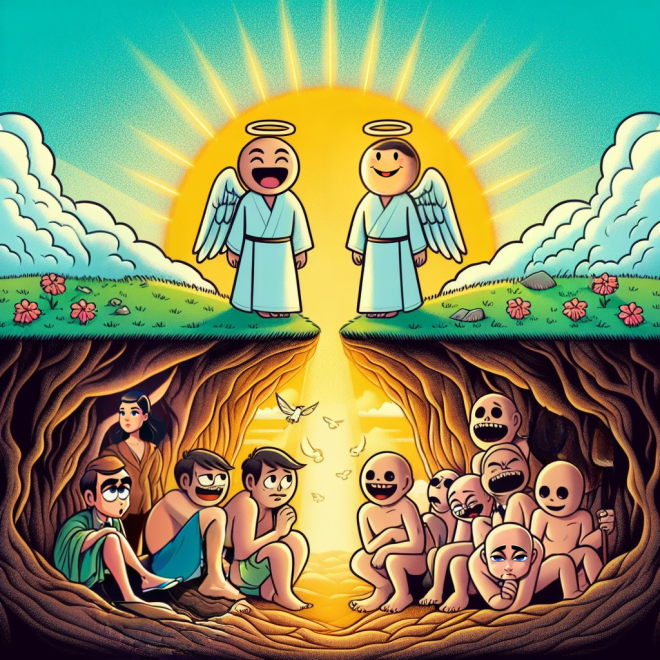
Imagine a lower level and an upper level constitutes all of Reality. This upper level is perfect, which in this ontological context means absolutely no fault and also being timeless/static/unchanging. In this view, humans (specifically their souls / spiritual components) are essentially trapped in the lower realm and want to go up to the upper, perfect realm above. Something needs to free you from the imperfect lower realm to elevate you to the upper realm, because you cannot cross over the divide. This is why it is called Unhappy Dualism, because as long as you are in the lower realm you will be “unhappy.” Any relationship between the two realms must be mediated by some kind of go-between. This ontological presupposition undergirds the worldviews of Transcendentalism, Gnosticism, Monasticism, Mysticism, Catholicism, many Christian religions, and some forms of the New Age etc. While each religion expresses this thought a little bit differently, each believe that within or inherent within each person is a “divine spark” or immortal soul that has come from the perfect spiritual realm above, and represents the only way the divide can be crossed. The idea of an immortal soul in Christianity was originally borrowed from the Greek (pagan) philosopher Plato (reference), who did not provide any real proof of its existence, but who probably got the idea from Animism. In this view, at the moment of conception an inherently immortal soul comes from the perfect, upper, spiritual realm and enters the human experience, then leaves at the point of bodily death to reenter the timeless heavenly realm. In this view, which is based on Greek philosophy, Heaven and God exist in this timeless, perfect realm; therefore, by implication, God cannot (at least directly) interact with the imperfect, lower, temporal realm. By implication, God is impersonal and distant due to this great, unhappy divide.
One interesting outgrowth of this ontological view (unhappy dualism) is that at least some proponents (whether consciously or subconsciously) believe that the truth can be found within you, since you have a “divine spark” or immortal soul residing in you. This leads to introspection, tolerance, individualistic thinking, relativism, and campaigning for one’s perceived “rights.” Along these lines, there are some who see within themselves a certain type of attraction, and thus think they need to express their “true” self in order to live out their perceived self-identity. But I digress….
Happy Dualism
In contrast to unhappy dualism, happy dualism presupposes that while both a lower and upper level exist, these two realms are not “at war” with each other, as the “divide” is crossable. This view seems to me to be present only within Christianity in some denominations. Happy dualism dictates there is an upper level, which is the realm of the Creator God, and a lower level, which is the realm of the created. The upper level is not timeless, but has time (therefore it is not strictly “perfect” as defined above). God thus dwell(s) in time (not necessarily restricted by our limited frame of reference though), and therefore God can access and interact with the created lower realm at will. There is no need for an immortal soul, since the “divide” is crossable by God at any time. A soul in this ontology is defined as a living being who has both a physical body and the divinely-given breath of life (not a separate, conscious entity) (e.g., Genesis 2:7).
Before moving on to discuss the next presupposition, I cannot but help discuss some specific implications of happy dualism in the context of Christianity. One big implication is that Heaven is within the created (“lower”) realm, thus it is a very real place, able to be experienced in time by created beings blessed by God to be taken there; however, this also means Heaven is not out of necessity “perfect” as defined above either. In fact, the Bible speaks of a time when there was war in Heaven, and Lucifer (Satan) and his angelic followers were cast down from out of Heaven by Michael the archangel and angels loyal to God (Revelation 12:7-9). This war apparently started when Lucifer, a created being, desired to be like the Creator, and that is a big problem, for it is impossible that a created being can enter the realm of the Creator God. The result was a separation between the Creator and His created beings who did not respect their created position. This great controversy was then carried over into the created human race when Adam and Eve fell (Genesis 3). The purpose of salvation in this view is to restore the harmony between God and His creation by eventually fully eliminating the separation caused by Lucifer, and involves the physical resurrection and glorification (i.e., given new [not inherently] immortal bodies by God) of created humans who chose to love and respect God because of His demonstration of His character seen at the cross of Calvary. This contrasts with the purpose of salvation in an unhappy dualism view, wherein the goal is arguably to have one’s immortal soul or spiritual part be reunited with the timeless, “perfect” realm.
Some Christians mixing ontologies?
Some Christians have tried to mix these two distinct presuppositional ontologies, believing in an immortal soul and a physical resurrection to live in Heaven, but these are really mutually exclusive views. If such Christians want to believe in a Heaven where the resurrected interact with each other in time, then they have to believe that the departed immortal soul must return from the “perfect,” upper realm, re-enter the resurrected physical body, and then dwell in Heaven, which in order to be consistent, cannot be the same timeless realm the immortal soul originally came from; in other words, the “saved” immortal souls, while in a relatively good place, are still stuck in a relatively “higher,” lower realm… forever… while the “unsaved” immortal souls are much worse off, being stuck forever in a “lower,” lower realm called “hell” where they are tormented… forever with no way out. This idea seems to me like it results in (subconscious?) cognitive dissonance. I would invite Christians to study the origin of their “Christian” beliefs–there may be a more logically consistent belief framework they have not considered. In the future, I will discuss more about how our foundational presuppositions affect our views of theology.
In my next post, I will examine the 4th and last of the foundational presuppositions: Epistemology.
 Biblical Lessons from Nature
5 thoughts on “Presupposition #3: Ontology”