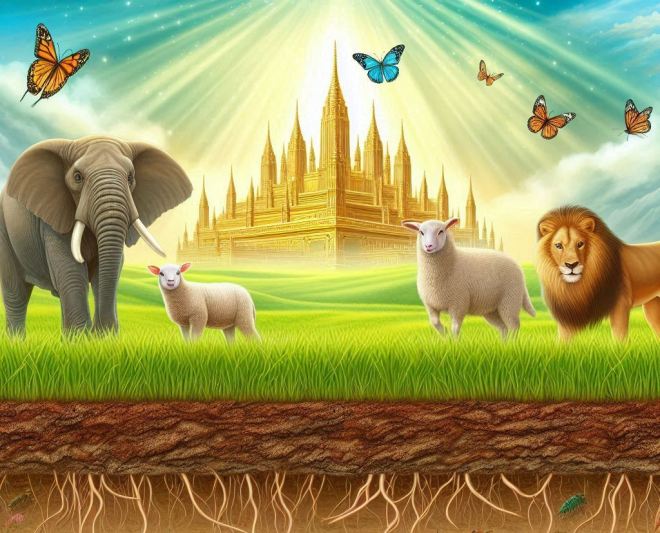
The Bible, particularly in Isaiah and Revelation, promises a renewed creation—a “new heavens and a new earth”—free from suffering, death, and pain (see Isaiah 65:17 and Revelation 21:1). This restoration signifies the complete removal of sin’s curse, leading to a world where harmony is perfectly re-established, all creatures are vegetarian, and fierce competition and predation cease to exist, as illustrated by the lion and lamb living peacefully together.
This raises the question of whether insects will be present in the New Earth, and the answer is yes; those originally created will be restored. While some insects currently appear designed for predation or parasitism, the text suggests two possibilities for their existence in the New Earth: either these specific predatory/parasitic insects will no longer exist, or they will be divinely transformed to live in perfect, harmonious, Edenic ways.
But have you ever thought about small ground animals in the New Earth? There is obviously an incredible diversity in the size and lifestyles of animals. So what if a large animal (maybe an elephant) while sauntering on the green plains in the New Earth, stepped on a piece of ground with a bunch of tiny insects or other very small animals there? How could those little critters not be crushed? How could a world exist where accidental death does not occur?
Such a concept challenges our modern understanding of ecological interactions and physical laws. We could get around the question entirely by saying that tiny insects and other small ground-dwelling animals simply would not exist as there would be no role for them in a world without decay. Yet, the inspired messenger of the Lord, Ellen G. White, states in regards to the Edenic pre-Fall world (which the New Earth restores even more perfectly) that “With every living creature, from the mighty leviathan that playeth among the waters to the insect mote that floats in the sunbeam, Adam was familiar.”[1] If tiny insects like midges were present in Eden before the Fall, then it is not a far stretch that at least some of the small insects that live on or in the ground that we have today would be present too. (While they would not have eaten decaying matter, they could have eaten parts of ground-dwelling plants.) Being present on the ground would make them subject to being stepped on and crushed to death by a larger animal. Yet somehow this did not occur in the pre-Fall world, for it was when Adam, who was familiar with the smallest creatures, made the first ceremonial sacrifice for sin that he witnessed death.[2]
If small ground-dwelling insects existed, they either were uncrushable and impervious to damage (possible only if God’s protection extended around every animal, which Inspiration is silent about), or the physical ground was very different than what we observe today—one inherently designed to prevent accidental death. The Spirit of Prophecy paints a vivid picture of the newly created Earth with hills, mountains, and plains, but lacking ragged, exposed rock.[3] The pre-Flood Earth is described as a landscape where hills and mountains possessed smooth, graceful contours, and vast plains were depicted as being “covered with verdure and lovely plants”—a landscape vibrant with ubiquitous, life-sustaining vegetation.[4] This portrayal stands in stark contrast to our current world, which bears the marks of dramatic geological changes and widespread disorder, a consequence of later events.
Unlike the pre-Flood Earth, the pre-Fall Earth was even devoid of death and decay (no sin yet), meaning that the ground created by God would have perfectly prevented the death of all small living creatures. While it is impossible to say exactly what this ground was like, we can imagine that it had a “spongy” nature to it that would have stemmed from a fundamentally different design than what we observe in current ecosystems. It would not have been due to decomposing organic matter, the action of fungi breaking down materials, or extreme saturation or dryness. Instead, its unique constitution would likely involve an inherently porous and structurally stable mineral composition, where the ground would have consistent internal voids for cushioning. Interwoven throughout this mineral base would be an incredibly dense and expansive living root matrix, possessing springiness and cohesive strength. Through a regularly occurring mist that watered the vegetation (cf. Gen. 2:6), the soil’s pore spaces would maintain ideal water content contributing to the ground’s ability to compress and rebound. Furthermore, this perfectly designed ground would be seamlessly covered by lush, soft vegetation such as verdant mosses, carpet-like grasses, and other low-lying flora, all entirely free of any sharp or brittle elements. This bio-mineral system would thus allow for significant compression absorption—potentially several centimeters of yielding and rebound—significantly preventing harm to small organisms from a large animal stepping on the patch of ground they are in. This divinely engineered substrate, with its integrated living components and perfectly regulated environment, would have allowed for seamless interaction and harmony, effectively preventing any accidental harm to even the smallest ground-dwelling creatures. Such a world, where the very soil responded to protect its smallest inhabitants, offers a powerful vision of comprehensive and thoughtful design. Unfortunately, the geological turmoil of the global Flood radically altered this original surface, transforming smooth, verdant plains into rugged terrains formed from accumulated stones, trees, and earth.[5] This dramatic change implies that the current, often unyielding and potentially dangerous ground we inhabit today is a profound departure from an initial state specifically designed for absolute safety and non-injury for all life.
What do you think? Leave your thoughts in the comment section below!
[1] White, Patriarchs and Prophets, 50.
[2] White, The Spirit of Prophecy, 1:53.
[3] White, 1:24.
[4] White, 1:81.
[5] White, Patriarchs and Prophets, 107–8.
 Biblical Lessons from Nature