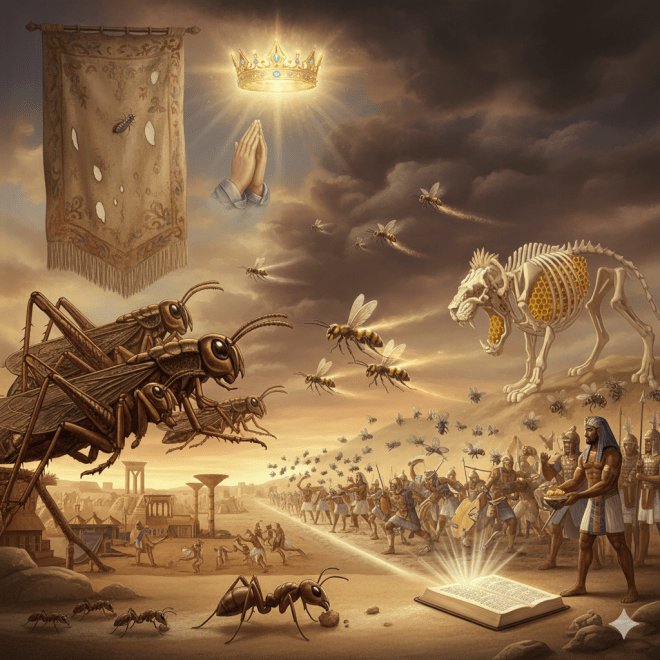
Think the Bible only talks about kings, prophets, and floods? Think again! Tucked away in the ancient texts are surprisingly frequent appearances by some of the smallest creatures on earth: insects. Far from being background noise, these tiny animals often step into the spotlight to reveal profound spiritual truths, showcase God’s immense power, and even give us surprisingly practical life advice. From displays of divine judgment that changed the course of history to humble lessons on saving money, let’s zoom in on the most memorable insect encounters in Scripture and discover the deep wisdom found in the world’s most amazing insects.
The Ten Plagues of Egypt: A Display of Divine Sovereignty
The dramatic narrative of the Ten Plagues of Egypt, recorded in Exodus, powerfully showcases God’s absolute control over all aspects of His creation, including seemingly insignificant insects. This display begins with the third plague, lice (Exodus 8:16-19), which immediately revealed God’s power over even the minutest creatures. As Pharaoh’s magicians, unable to replicate the feat, declared, “This is the finger of God,” they acknowledged the Creator’s immense power and challenged Egyptian polytheism. Following this, the fourth plague, flies (Exodus 8:20-32), created a clear distinction between the Egyptians and the Israelites, with swarms afflicting only Egypt while Goshen, where the Israelites resided, remained untouched. This highlighted God’s protective care for His people and His ability to discriminate. Finally, the eighth plague, locusts (Exodus 10:1-20), brought horrifying devastation, consuming every green thing left after the hail and leaving the land desolate. This served as a stark reminder of divine judgment against persistent rebellion, as the locusts, appearing and disappearing at God’s command, functioned as instruments of His will.
Israelite Battles and Divine Intervention: Unseen Allies
God’s use of insects extends beyond the plagues, sometimes employing them as strategic allies in Israelite battles, underscoring His sovereignty over all creation to achieve His purposes. Throughout the conquest of Canaan, God promised to send hornets (Exodus 23:28, Deuteronomy 7:20, Joshua 24:12) before the Israelites to drive out their enemies. “And I will send hornets before thee, which shall drive out the Hivite, the Canaanite, and the Hittite, from before thee.” This divine intervention, using stinging insects to instill fear and chaos among the enemy, showcases God’s willingness to use unconventional means to clear the way for His people and fulfill His promises. It serves as a powerful reminder that “the battle is the Lord’s.”
Samson and the Lion: Honey from a Carcass
In the Book of Judges, Samson’s wrestling match with a lion (Judges 14:8-9) produces a pivotal moment that fuels his conflict with the Philistines. While traveling, Samson was attacked by a lion, which he killed with his bare hands. Sometime later, returning to the lion’s carcass, he discovered a hive of bees with honey inside. This unexpected finding became the basis of a riddle Samson posed to the Philistines at his wedding feast: “Out of the eater came forth meat, and out of the strong came forth sweetness.” When the Philistines could not solve the riddle on their own, they resorted to pressuring Samson’s bride, who then tricked him into revealing the answer to avoid having to pay Samson. Their deception enraged him, and he set out to avenge himself against them. This incident, orchestrated by divine providence, served to set Samson back on a course to contend against the Philistines for the sake of the Israelites.
Ants: Proverbial Wisdom and Diligence
The humble ant, a creature often overlooked, receives significant attention in the book of Proverbs, offering profound lessons in wisdom and practical living. Proverbs 6:6-8 advises, “Go to the ant, thou sluggard; consider her ways, and be wise: Which having no guide, overseer, or ruler, Provideth her meat in the summer, and gathereth her food in the harvest.” This passage highlights the remarkable foresight and diligence of the ant colony, demonstrating its ability to collectively prepare for future needs without supervision. Proverbs 30:24-25 further celebrates the ant: “There be four things which are little upon the earth, but they are exceeding wise: The ants are a people not strong, yet they prepare their meat in the summer.” Here, the ant colony is lauded for its exceedingly wise, proactive preparation and organized, collective labor, rather than the strength of individual ants. The industry, foresight, and social organization of ant colonies offers timeless lessons in diligence, planning, and unified effort.
While a single ant may appear insignificant, the collective effort of a colony achieves remarkable feats, diligently seeking and gathering food wherever it’s found—even entering buildings and climbing up through cracks and crevices to secure their provisions. This tireless pursuit of sustenance serves as a profound metaphor for the spiritual life: if we diligently seek the “Bread of Life,” Jesus, with the same persistent and unwavering effort, He promises to reveal Himself, transform our lives, and impart true wisdom. This wisdom, unlike fleeting earthly possessions, is gained not through idleness or preoccupation with worldly pursuits, but through a committed, active search for God’s presence and righteousness.
Moths: The Ephemeral Nature of Earthly Possessions
In the New Testament, insects, specifically moths, serve as poignant symbols of the transient nature of material wealth, guiding us towards eternal values. Matthew 6:19-20 instructs, “Lay not up for yourselves treasures upon earth, where moth and rust doth corrupt, and where thieves break through and steal: But lay up for yourselves treasures in heaven, where neither moth nor rust doth corrupt, and where thieves do not break through nor steal.” Here, Jesus uses the destructive power of moths to illustrate the impermanence of earthly possessions. It is not the adult moths that cause damage, as they lack the necessary mouthparts and are primarily concerned with mating and laying eggs. Rather, it is the larvae (caterpillars) of various moth species, particularly those belonging to the family Tineidae (clothes moths), that consume valuable fabrics like wool, silk, and fur, attracted to the keratin protein they provide. This imagery calls us to re-evaluate our priorities, reminding us that true and lasting treasures are not found in perishable earthly goods, but in spiritual investments that transcend the limitations of this world.
Summary
Far from being background characters, the Bible’s insects deliver profound and timeless lessons about God’s power and practical living. The plagues of lice, flies, and locusts in Exodus showcased Divine Sovereignty and Judgment, proving God’s absolute control over every aspect of creation and distinguishing His people. The promised hornets demonstrated Divine Intervention, reminding us that God uses unconventional means to win the battle for Israel. The discovery of honey by bees in a carcass showed Divine Providence, fueling Samson’s conflict with the Philistines. The humble ant offers crucial guidance on diligence and foresight, urging us to proactively prepare for the future and persistently seek spiritual sustenance. Finally, the destructive power of moths serves as a stark warning about the transient nature of material wealth, compelling us to prioritize eternal, spiritual treasures over earthly possessions. These tiny creatures collectively affirm that no detail in creation is too small to be an instrument of God’s power or a living illustration of His profound wisdom.
 Biblical Lessons from Nature