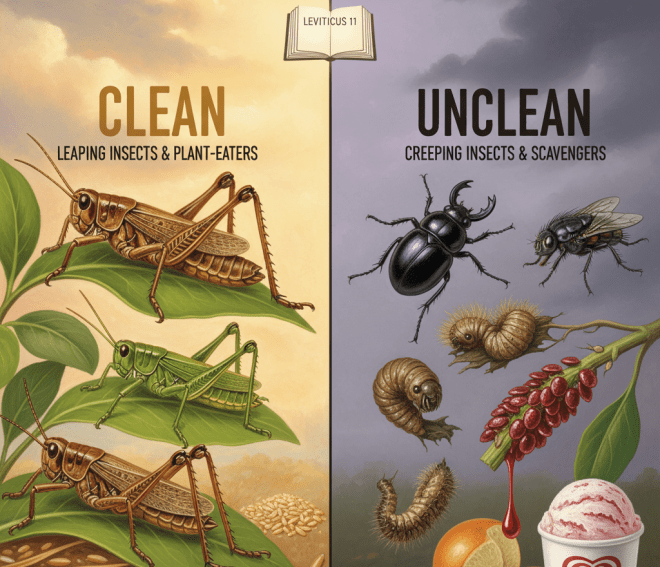
In a world teeming with an astonishing array of life, the Bible presents intriguing dietary guidelines, particularly when it comes to what is permissible to eat. For many, these ancient laws may seem antiquated or irrelevant in modern times. However, from a thoughtful perspective, these instructions offer profound insights into God’s wisdom and care for humanity, extending even to the seemingly minor details of our diet.
Following the global Flood, a pivotal moment in Earth’s history, humanity was given new dietary parameters. While the pre-Flood world was described as entirely plant-based for sustenance, a significant shift occurred post-Flood, allowing for the consumption of animal flesh. It is within this broader context of divine provision and guidance that the specific laws concerning clean and unclean animals, meticulously detailed in the book of Leviticus, find their place. These laws were not arbitrary restrictions, but rather, a structured framework intended to guide the health and spiritual well-being of God’s people.
Let us turn our attention specifically to insects, as found in Leviticus 11, focusing on verses 20-23 as rendered in the King James Version:
“All fowls that creep, going upon all four, shall be an abomination unto you. Yet these may ye eat of every flying creeping thing that goeth upon all four, which have legs above their feet, to leap withal upon the earth; Even these of them ye may eat; the locust after his kind, and the bald locust after his kind, and the beetle after his kind, and the grasshopper after his kind. But all other flying creeping things, which have four feet, shall be an abomination unto you.“
This passage clearly distinguishes between various “flying creeping things,” designating some as permissible for consumption and others as abominable. (You may wonder, “Four feet?! I thought insects had six!” The initial reference to four feet is a non-technical description of their crawling motion; the key is not the number, but the mode of movement). The permitted insects are characterized by “legs above their feet, to leap withal,” specifically mentioning the locust, the bald locust, the beetle, and the grasshopper “after his kind.” The Hebrew word for “beetle” in this passage, “chargol” (Strong’s h2728), means “leaping insect,” or “(a kind of) locust.” Almost all other Bible versions translate “chargol” as “cricket,” but since crickets are omnivorous and not exclusive plant-eaters, it is unlikely that “cricket” is what was meant.[1] Since real beetles (or similar bugs) do not leap, they must be unclean insects not to be eaten. In contrast, grasshoppers and locusts belong to the order Orthoptera, have hind legs specialized for jumping, wings, and mouthparts for chewing vegetation, and thus are considered clean and permissible to eat.
What then is the interpretation and relevance of these guidelines for a modern diet? From a health perspective, all animals designated as clean animals are primary consumers, eating plants, as opposed to the unclean animals which typically eat carrion, decaying matter, and other animals. Due to the accumulation of toxins and disease-causing organisms (especially as one goes up the food chain), the “unclean” animals are generally more prone to carrying parasites or diseases.[2] Unclean insects include crickets, beetles, flies, and all grub-like or caterpillar-like larvae. Bugs with sucking mouthparts are also unclean, including scale insects in the orders Homoptera and Hemiptera. This is significant because cochineal/carmine is a red dye produced from the dried bodies of Dactylopius coccus, “beetle-like” scale insects in the order Homoptera having sucking mouthparts.[3] Unfortunately for those wishing to avoid it, carmine (this red dye) is commonly found in “natural color” of fruit juices, cocktails, ice cream, chewing gum, and many other prepared foods, making it important to read labels carefully.[4]
Many will try to dismiss this careful avoidance as legalism, claiming that these Levitical dietary laws were part of the ceremonial law that was done away with; however, while Leviticus 11 and Deuteronomy 14 give a detailed listing of clean and unclean animals, the concept of clean and unclean animals is present at least since God instructed one pair of each kind of unclean animal and seven pairs of each kind of clean animal to enter the ark (cf. Genesis 7:2). This suggests the distinction went beyond mere symbolism or ceremonialism but had practical health and ecological implications. In any case, the principle of discerning wholesome from unwholesome food remains relevant (cf. 1 Cor. 6:19-20). From a foundational biblical perspective, the optimal diet for humanity would be the Edenic plant-based diet of fruits, grains, legumes, nuts, and seeds (plus vegetables after the Fall to strengthen against disease), and scientific research has shown benefits to such a diet.[5] Nevertheless, for individuals who consume animal products, acknowledging and understanding the Bible’s dietary guidelines in Leviticus 11 provides a significant framework for informed and conscientious choices.
[1] Clean and unclean in the Bible. (2024, May 8). Amazing Discoveries. http://amazingdiscoveries.org/read/articles/7
[2] (Clean and Unclean in the Bible, 2024)
[3] The Israel of God Research Committee. (n.d.). Cochineal/Carmine. Retrieved May 30, 2025, from https://www.theisraelofgodrc.com/cochineal.htm
[4] (Clean and Unclean in the Bible, 2024)
[5] Le, L. T., & Sabaté, J. (2014). Beyond meatless, the health effects of vegan diets: Findings from the Adventist cohorts. Nutrients, 6(6), 2131–2147. https://doi.org/10.3390/nu6062131; Orlich, M. J., & Fraser, G. E. (2014). Vegetarian diets in the Adventist Health Study 2: A review of initial published findings. The American Journal of Clinical Nutrition, 100(suppl_1), 353S-358S. https://doi.org/10.3945/ajcn.113.071233
 Biblical Lessons from Nature