Have you ever thought about what the existence of messages and functionally complex information means for life’s origin? Read this article to find out!

Have you ever thought about what the existence of messages and functionally complex information means for life’s origin? Read this article to find out!

The most important theological issue for a Christian is determined by whether they think God’s sovereignty or character is most important, and this decision itself depends on whether one believes humanity has true free will.

Does God exist? This post looks at the approaches at answering this question. Is it really insensible to claim the supernatural exists and an infinitely-powerful Creator has designed and rules the created realm?

The previous four posts examined what I consider to be the four foundational presuppositions: Being, Metaphysics, Ontology, and Epistemology. Here I will give the presuppositions that I have chosen.

Epistemology deals with knowledge. There are two foundational epistemological options: (1) Believe in Absolute Truth, or (2) Believe there is NO Absolute Truth, but instead only relative truths.
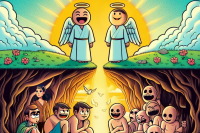
Ontology deals with your concept of universal Reality. There are three possible ontologies: Materialism, Unhappy Dualism, and Happy Dualism.
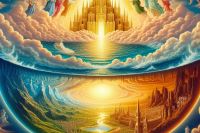
Metaphysics is the question of whether there is a supernatural part to Reality or not. Is the natural world open or closed? Is there something beyond the material world?

Being focuses on pure existence itself. What is existence? Is one’s existence timeless or temporal? Is time linear or cyclical?

A worldview shapes our perspective on life, serving as the foundation for our choices and understanding of reality.
 Biblical Lessons from Nature